

🔓 📢 Day 7/30 - DEEP DIVE SOLUTIONS : SQL, PYTHON, ETL, DATA MODELLING
Solutions for March 4th, 2025 CHALLENGE – Unlock the Full Breakdown + Live Runnable Code!

👋 Hey Data Engineers!
Welcome to Day 7 of the 30-Day Data Engineering Challenge 🚀.
Today’s Deep Dive covers:
✅ SQL Self Joins (Comparing Rows in the Same Table)
✅ Python List Sorting (Understanding .sort() vs. sorted())
✅ ETL Error Handling (Logging & Skipping Faulty Records)
✅ Fact vs. Dimension Tables (Optimizing Data Warehouse Design)
🔥 **Drop your thoughts in the comments & let’s keep leveling up!**👇
📌 SQL Challenge - Mastering SELF JOIN (Deep Dive & Optimizations)
Understanding SELF JOIN
A SELF JOIN is when a table joins with itself, typically to compare rows within the same dataset.
🔹 Where It’s Used in Real-World Applications?
✅ Employee Hierarchies: Find employees who have the same manager.
✅ Customer Referral Tracking: Match customers who were referred by the same person.
✅ Fraud Detection: Identify duplicate transactions made by the same user.
Run & Test on onecompiler.com
1️⃣ Open onecompiler.com, select SQL (PostgreSQL or MySQL).
2️⃣ Copy and paste the SQL query below:
-- Create a sample employees table
CREATE TABLE employees (
    emp_id INT PRIMARY KEY,
    name VARCHAR(100),
    manager_id INT
);

-- Insert sample employee data
INSERT INTO employees VALUES
(1, 'Alice', NULL),
(2, 'Bob', 1),
(3, 'Charlie', 1),
(4, 'David', 2),
(5, 'Emma', 2);

-- Using SELF JOIN to find employees with the same manager
SELECT e1.name AS employee, e2.name AS colleague, e1.manager_id
FROM employees e1
JOIN employees e2 ON e1.manager_id = e2.manager_id
WHERE e1.emp_id <> e2.emp_id;
3️⃣ Click Run and analyze the results.
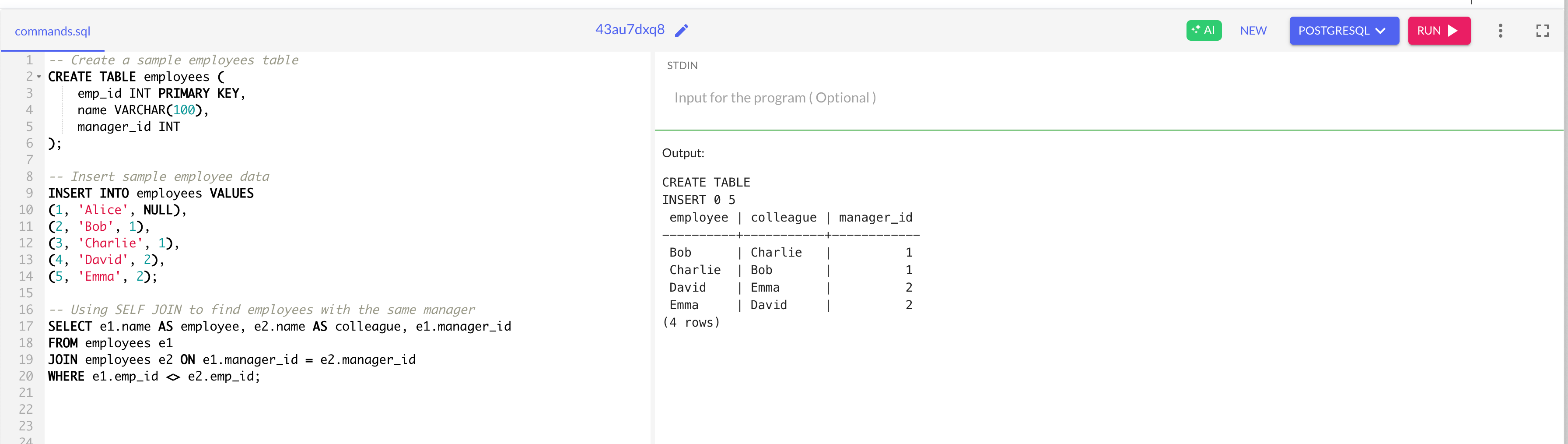
🔍 What’s Happening?
✔ Pairs employees who share the same manager!
✔ Self joins are useful for hierarchical relationships.
🔹 Optimizations & Best Practices
✅ Use SELF JOIN when comparing rows within the same table.
✅ Use INDEX on the foreign key (manager_id) for better performance.
✅ Avoid unnecessary self-joins if alternative queries (e.g., window functions) are more efficient.
